Prevent RAG Data Leaks: Inject Tenant Filters Into Qdrant Queries
Don't concatenate WHERE tenant_id. inject_filter wraps untrusted QQL in a root AND so OR and NOT cannot skip isolation.
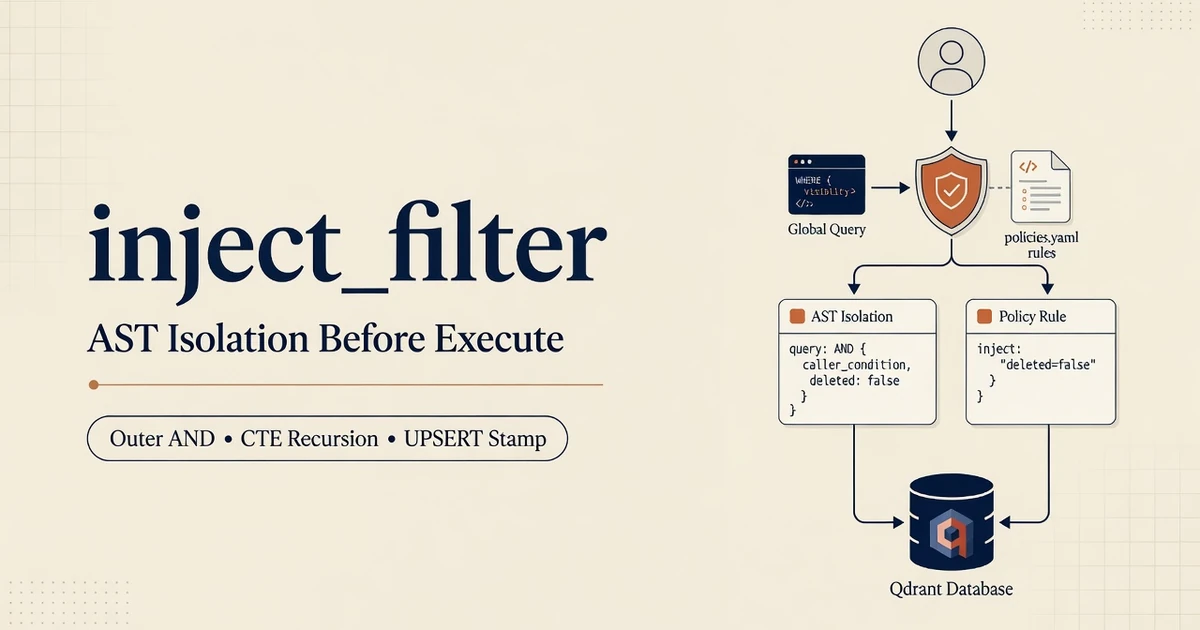
RAG data leaks happen when the tenant filter is missing, concatenated, or wrapped in an OR. inject_filter() is a typed AST rewrite: after parse, before plan, it puts tenant_id = 'acme' (or whatever comparison you pass) on the root AND of the statement.1 It does not authenticate. It does not read JWTs. The process that already knows the caller must call it.
String concat (WHERE tenant = 'acme' AND ( + user_qql + )) fails as soon as the user query contains OR or NOT. The tests in this repo cover those bypasses, CTE recursion, and UPSERT stamping.12 A full JWT gateway used to live in archived qql-go; the walkthrough is still in the gateway post. This page is the primitive current QQL still ships: call inject_filter in your host.
Parse, inject, then plan. Never concat.
Production security pipelines enforce a strict sequence of execution stages before statements reach the database engine:
authenticate → authorize → parse → inject_filter → inspect → plan → execute1.1 The Seven-Stage Security Pipeline
Attempting to enforce policy through text manipulation fails because string formatters cannot evaluate nested logical operators, Common Table Expressions (CTEs), or prefetch query branches. Typed AST transformation parses input text into structured nodes before applying structural transformations:
import pyqql
import json

raw_query = (
    "QUERY TEXT 'price adjustment policy' FROM knowledge "
    "USING dense "
    "WHERE visibility = 'public' OR visibility = 'partner' "
    "LIMIT 10"
)

# Parse raw string into Abstract Syntax Tree
statement = pyqql.parse(raw_query)[0]

# Inject mandatory security filter at the AST root
pyqql.inject_filter(statement, "deleted", "=", False)

# Print transformed AST filter representation
print("Transformed Filter AST:")
print(json.dumps(statement.to_dict()["Query"]["filter"], indent=2))

# Inspect execution plan
print("\nGenerated Execution Plan:")
print(pyqql.explain(statement)["plan"])
1.2 Structural AST Inspection Before Execution
Parsing input text into a typed Abstract Syntax Tree guarantees that structural query boundaries are established before security filters are injected. String formatting techniques operate on raw characters, making them vulnerable to unexpected quote escaping or parenthesis imbalance. In contrast, AST transformation operates on validated node trees, ensuring that security predicates are merged into exact logical positions.
Applying security policies at the AST layer allows host processes to inspect query structure before sending compilation plans to database engines. Security teams can log transformed AST representations to prove that mandatory tenant boundaries were applied to every outgoing request.
Why a root AND beats OR and NOT bypasses
Before filter injection, the AST filter consists of an Or node combining two visibility conditions. Invoking inject_filter(statement, "deleted", "=", False) wraps the existing expression inside a root And node:
2.1 AST Structural Transformation Output
{
  "And": {
    "operands": [
      {
        "Or": {
          "operands": [
            { "Compare": { "field": "visibility", "op": "Eq", "value": { "Str": "public" } } },
            { "Compare": { "field": "visibility", "op": "Eq", "value": { "Str": "partner" } } }
          ]
        }
      },
      {
        "Compare": {
          "field": "deleted",
          "op": "Eq",
          "value": { "Bool": false }
        }
      }
    ]
  }
}
2.2 Proof of Resistance Against Negation Attacks
The generated execution plan reports Filter: present. User-supplied conditions occupy operand position 0 inside the root And node, while injected security policies occupy operand position 1.
The identical structural guarantee applies to negation attacks. If a caller submits WHERE NOT tenant_id = 'acme', injecting tenant_id = 'acme' produces an explicit logical contradiction (NOT tenant_id = 'acme' AND tenant_id = 'acme'), yielding zero match results and preventing unauthorized record access. This security invariant is verified by core integration tests (injection_resists_negation_bypass).2
Root AND node wrapping guarantees that user-supplied logical conditions can never expand the search space beyond injected tenant constraints.
Supported filter comparison operators include =, >, >=, <, and <=. Non-deterministic or broad operators such as !=, IN, or MATCH are restricted from injection to keep policy primitives predictable.1
Evaluating policy nodes inside a root And container ensures that user-supplied logical conditions can never expand the search boundary beyond injected constraints. Even if a malicious input constructs elaborate logical trees containing nested OR conditions or inverted NOT expressions, the root And wrapper guarantees that injected tenant constraints remain mandatory across all evaluated branches.
Recurse into CTEs and prefetches
Complex retrieval queries frequently use Common Table Expressions (WITH blocks) and subquery prefetch clauses to fetch candidate vectors across multiple indices:
3.1 CTE and Prefetch Query Structure
import pyqql

query_with_ctes = """
WITH
  dense_candidates AS (QUERY TEXT 'security audit' FROM knowledge USING dense LIMIT 100),
  sparse_candidates AS (QUERY TEXT 'security audit' FROM knowledge USING sparse LIMIT 100)
QUERY TEXT 'security audit' FROM knowledge
USING dense
PREFETCH (dense_candidates, sparse_candidates)
LIMIT 10
"""

statement = pyqql.parse(query_with_ctes)[0]

# Inject policy filter across main query and all subqueries
pyqql.inject_filter(statement, "project_id", "=", "proj_9921")

ast_tree = statement.to_dict()["Query"]

# Verify root query filter
assert ast_tree["filter"]["Compare"]["field"] == "project_id"

# Verify recursive injection into CTE subqueries
assert ast_tree["ctes"][0]["query"]["filter"]["Compare"]["value"]["Str"] == "proj_9921"
assert ast_tree["ctes"][1]["query"]["filter"]["Compare"]["value"]["Str"] == "proj_9921"
print("Recursive CTE filter injection verified successfully.")
3.2 Preventing Candidate Leakage in Hybrid Search
Restricting filter injection to the outer query block allows candidate generation subqueries to scan unrestricted index spaces. Recursive AST traversal ensures mandatory tenant conditions are applied to every subquery branch within the statement tree.
Subquery prefetch clauses used in hybrid retrieval workflows are equally vulnerable to tenant isolation leaks if left un-policed. When candidate generation subqueries retrieve vectors without tenant constraints, unauthorized candidate vectors enter fusion scoring pipelines. Applying inject_filter() recursively across all CTE definitions and prefetch trees eliminates candidate leakage across multi-stage retrieval pipelines.
Stamp tenant keys on UPSERT payloads
When executing point ingestion via UPSERT, equality filter injection modifies point payload dictionaries directly, writing specified key-value pairs without altering record identifiers:
4.1 Provenance Payload Ingestion Example
import pyqql

upsert_query = "UPSERT INTO documents VALUES {id: 402, text: 'Q3 Security Roadmap'}"
statement = pyqql.parse(upsert_query)[0]

# Inject ingestion provenance tag into point payload
pyqql.inject_filter(statement, "ingestion_batch", "=", "2026-07-30-import-01")

point_payload = statement.to_dict()["Upsert"]["points"][0]["payload"]
print("Updated Point Payload:", point_payload)
# Output contains: ["ingestion_batch", {"Str": "2026-07-30-import-01"}]
4.2 Fail-Closed Validation Matrix across Statement Types
Production ingestion pipelines should stamp immutable execution IDs into point payloads rather than mutable labels, ensuring ingestion history can be audited across storage layers.
Stamping provenance metadata during UPSERT operations simplifies data lifecycle management and auditing. When data pipelines import points from external feeds, injecting batch identifiers, pipeline versions, or ingestion timestamps ensures that records can be tracked or purged selectively using payload matching filters.
QQL 0.1.5 implements strict fail-closed enforcement when inject_filter() is invoked against unsupported statement types:
| Statement Category | AST Transformation Behavior | Operational Result |
|---|---|---|
QUERY |
Merges policy filter into root And node; recurses CTEs and prefetches |
Filter applied to retrieval |
SCROLL, COUNT |
Merges policy filter into query filter payload | Filter applied to aggregation |
DELETE, UPDATE PAYLOAD, CLEAR PAYLOAD |
Merges policy filter into deletion selector | Operation scoped by policy |
UPSERT (Equality on Non-ID Field) |
Stamps key-value pair into point payload dictionary | Ingestion provenance recorded |
DDL / SHOW / UPDATE VECTOR |
Rejects statement with QQL-VALIDATION-FILTER-INJECT error |
Operation blocked immediately |
Fail-closed validation turns untrusted query manipulation into a structural error before unvalidated statements can reach database ports.
Isolation is not shard routing
A common architectural misunderstanding equates physical database sharding with tenant isolation. In QQL 0.1.5, security filters and node routing are explicitly decoupled:
5.1 System Layer Responsibility Separation
| System Layer | Operational Tool | Wire Mechanism |
|---|---|---|
| Security Isolation | inject_filter() or WHERE clause |
Qdrant Filter payload matching |
| Physical Routing | SHARD 'key' clause or stmt.shard_key |
REST shard_key / gRPC ShardKeySelector |
| Index Layout | CREATE INDEX … is_tenant = true |
Payload index optimization |
| Partition Management | CREATE SHARD KEY 'key' |
Cluster administration API |
5.2 Programmatic Partition & Isolation Workflow
import pyqql

statement = pyqql.parse("QUERY TEXT 'audit' FROM docs USING dense LIMIT 10")[0]

# Security Isolation: Mandatory filter enforced via AST
pyqql.inject_filter(statement, "tenant_id", "=", "acme")

# Physical Routing: Target node selector (valid on custom-sharded collections)
statement.shard_key = "acme"
There is no inject_shard_key function in QQL 0.1.5. Node routing improves query performance and data locality, but security isolation depends entirely on inject_filter() and WHERE conditions. Distributed clusters handle physical sharding, whereas local edge runners evaluate filters in-process as detailed in our local edge search post.
Decoupling isolation filters from physical node routing protects applications against data leakage during cluster rebalancing or partition migrations. Node routing directs network traffic to specific hardware nodes, but inject_filter() guarantees that query execution remains constrained by payload security predicates across all nodes. The Go gateway and Go CLI posts document the archived qql-go tree. Isolation in current QQL is this inject_filter API.
Host policies you can actually encode
Filter injection supports diverse security and operational constraints beyond tenant isolation:
6.1 Enterprise Security Policy Specifications
| Security & Governance Policy | Applied Filter Specification | Engineering Purpose |
|---|---|---|
| Soft Delete Enforcement | deleted = false |
Excludes archived records from retrieval |
| Environment Scoping | environment = 'production' |
Prevents staging record exposure in production |
| Multi-Region Compliance | region = 'eu-central-1' |
Restricts data access to authorized geographic regions |
| Content Moderation | moderation_status = 'approved' |
Filters unverified user content |
| Multi-Tenant Isolation | tenant_id = 'org_4412' |
Enforces multi-tenant data boundaries |
| Pipeline Ingestion Provenance | ingested_by = 'etl_worker_v3' |
Stamps audit metadata during UPSERT operations |
6.2 Sequential Policy Stacking in CI/CD
Multiple filter calls can be stacked sequentially. Engineering teams should include automated snapshot assertions in CI pipelines, verifying transformed AST structures for both simple queries and complex CTE subqueries across all target language bindings (Rust, Python, Node, WASM).
Stacking multiple security policies enables fine-grained access control models. For example, an enterprise retrieval endpoint can enforce tenant isolation, soft-delete filtering, and region compliance simultaneously by applying sequential inject_filter() transformations to a single parsed statement tree before execution. For governed workflows, consult our Governed Code Mode guide and Schema-First LLM Wiki post.
Frequently asked questions
How do I prevent a RAG data leak in Qdrant?
Do not let the client, or the model, own the tenant filter. Parse the query, call inject_filter with the authenticated tenant, then plan. Payload filters that the caller can omit are not isolation. See also the archived gateway design.
Why is string concatenation not enough?
WHERE tenant = 'acme' AND ( + user_input + ) is still text. OR true or a NOT around the tenant clause walks out of the wrap. An AST rewrite puts the tenant comparison on the root AND after parse, so those shapes cannot drop it.
Does inject_filter replace SHARD?
No. inject_filter / WHERE decide which points may appear. SHARD decides which node receives the request. Mixing them is how people accidentally treat routing as a security control.
What if the statement is DDL?
It fails closed with QQL-VALIDATION-FILTER-INJECT. Isolation is for DML. Do not silently no-op on CREATE / DROP.
Footnotes
-
QQL. Host isolation architecture and filter injection specification. docs/inject_filter.md(opens in a new tab). ↩ ↩2 ↩3
-
QQL. Core AST transformation and logical bypass test suites (
injection_resists_logical_or_bypass, CTE recursion, UPSERT payload stamping). transform_tests.rs(opens in a new tab). ↩ ↩2