Query Qdrant From the CLI Without Writing SDK Code
qql-go is archived. Use the qql CLI from qql-rs for CI, runbooks, and agent-safe Qdrant retrieval. This post is the original design.
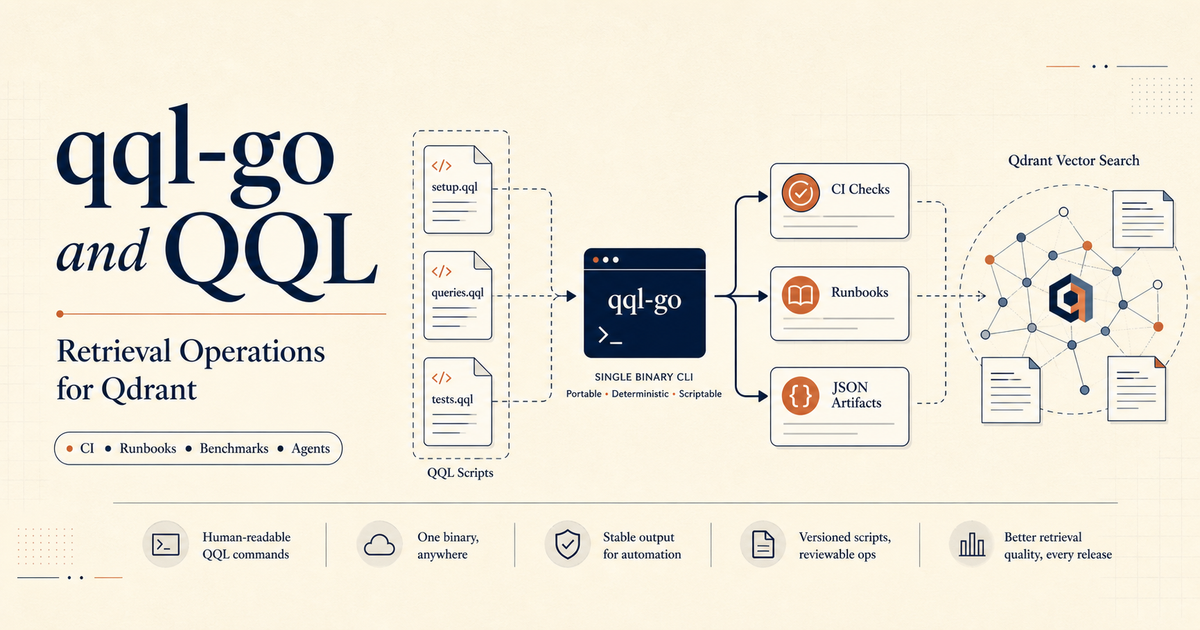
TL;DR
- Postgres has
psqland.sqlfiles in CI. Qdrant usually has a notebook and a JSON fixture that drifted.- QQL is SQL-like statements for Qdrant. The current CLI is
qqlfrom qql-rs.qql-gowas the Go binary this post was written against.- Give an agent the CLI with a read-first allow-list. Do not give it the cluster key.
- App servers can keep using the Qdrant SDK. The CLI is for ops, CI, and sandboxes.
You can query Qdrant from the CLI without writing SDK code. Put statements in a .qql file, run qql, get JSON back. Same files in CI as on the laptop. Hybrid search, filters, and explain live in git instead of a Python script nobody re-runs.
curl -fsSL https://raw.githubusercontent.com/srimon12/qql-rs/main/scripts/install.sh | sh
# or: cargo install qql-cli --locked
qql exec smoke-tests.qql
Production request paths can stay on qdrant-client. The CLI is the ops surface: a regression gate, a support runbook, a tool an agent is allowed to call.
The command snippets below still say qql-go. That is what the archived binary used. On current QQL, the equivalent is qql.
QQL Did Not Start With qql-go
QQL did not start in Go. The original project was created by Kameshwara Pavan Kumar Mantha as a SQL-like query language and CLI for Qdrant built on top of the Python SDK1. It maps readable statements like SEARCH, INSERT, SCROLL, RECOMMEND, UPDATE, DELETE, and CREATE COLLECTION to the underlying database engine.
The Python implementation is a mature query engine. It supports hybrid dense-sparse queries, reranking logic, payload index creation, quantization, and data dump/restore scripts1. It remains the optimal interface for notebooks, data-science scripts, and workflows inside the Python ecosystem.
qql-go is an independent Go implementation designed to translate those same language concepts into a single compile target2. I maintain the Go CLI and contribute to the Python repository, meaning this is not a fork-versus-original conflict, but rather a single language idea running across different environments.
The operational boundaries split logically:
- Qdrant SDKs: Expose the full client API inside your application’s hot path.
- Python QQL: Powers interactive data-science notebooks, evaluation scripts, and Python orchestration.
- qql-go: Serves as a single, zero-dependency binary with version-controlled
.qqlscripts, structured JSON output, and CLI assertions for CI and agent tools.
The SDK builds the application. QQL makes retrieval work readable. qql-go makes that work portable.
Why vector search needs a CLI the way SQL needs psql
Traditional databases fail loudly. If a service runs out of memory or a database connection drops, your APM tools throw stack traces and trigger alerts. RAG systems, however, fail quietly.
A minor tweak in the chunking parameters moves the golden document from rank 3 to rank 11. An embedding model update improves average recall across 90% of requests but silently degrades performance on a subset of high-value corporate terms. A schema change on a metadata field quietly causes runtime filters to stop matching.
The application still returns 200 OK. The LLM continues generating confident, fluent prose. But the retrieval quality has degraded.
To solve this, operations teams must ask deterministic questions:
- Did this critical query return the exact expected document ID?
- How does hybrid search performance compare to dense-only or sparse-only search?
- Are payload indexes still applied after a schema migration?
- Did latency or retrieval sizes drift beyond our SLA thresholds?
Most teams solve this with ad hoc scripts and local notebooks. qql-go shifts this into a portable command line interface:
qql-go exec --quiet --json \
  "SEARCH docs SIMILAR TO 'refund policy' LIMIT 3 USING HYBRID"
This structured command can be checked into git, executed by cron jobs, or integrated directly into deployment checkouts.
Workflow 1: Retrieval Regression CI
The most valuable role for qql-go is acting as a regression check in your CI/CD pipeline.
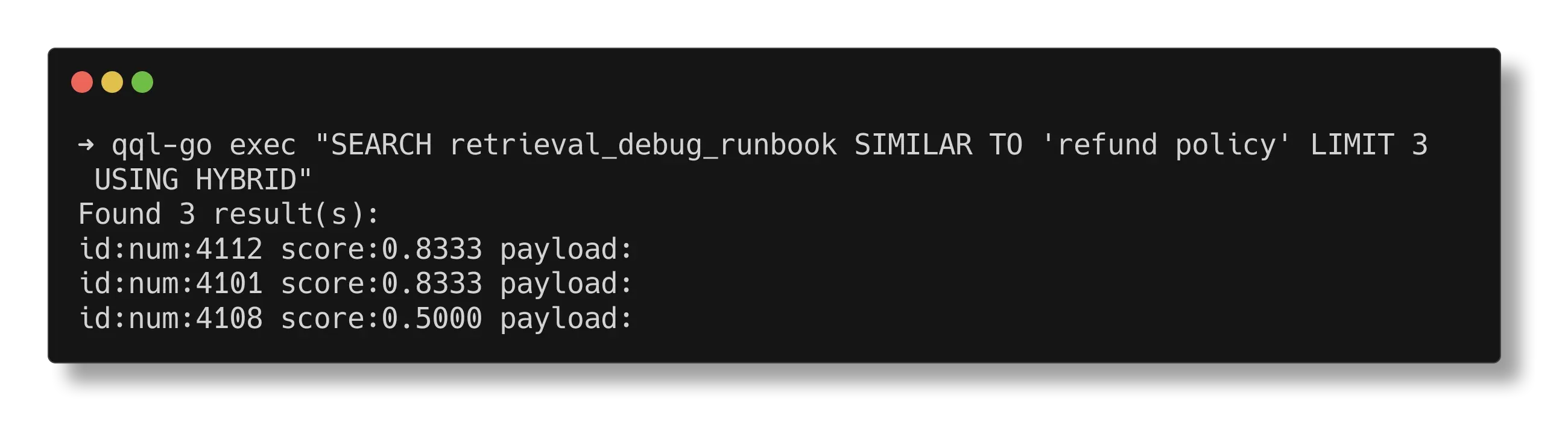
When a pull request introduces updates to vector dimensions, chunking limits, or payload schemas, teams must verify that retrieval quality has not drifted. The release-validation example in the qql-go repository treats this as a test assertion gate5.
The expectations are codified in a JSON suite:
{
  "collection": "release_validation_docs",
  "collection_expect": {
    "topology": "hybrid",
    "min_points": 6,
    "payload_indexes": ["team", "title"]
  },
  "checks": [
    {
      "id": "04-hybrid-refund",
      "command": "exec",
      "statement": "SEARCH release_validation_docs SIMILAR TO 'refund policy for annual plan' LIMIT 3 USING HYBRID",
      "expect": {
        "min_results": 3,
        "hybrid": true,
        "top_ids": ["1101"]
      }
    }
  ]
}
This JSON file ensures the target collection meets basic requirements (hybrid setup, minimum document counts, index coverage) and asserts that a hybrid query for "refund policy for annual plan" returns document 1101 in the top 3 positions.
GitHub Actions then installs current qql from qql-rs and executes the suite against the staging database:
name: retrieval-regression

on:
  pull_request:
    paths:
      - "examples/release-validation/**"
      - ".github/workflows/retrieval-regression.yml"

jobs:
  retrieval-regression:
    runs-on: ubuntu-latest
    steps:
      - uses: actions/checkout@v4

      - name: Install qql (current: qql-rs, not archived qql-go)
        run: |
          INSTALL_DIR="$RUNNER_TEMP/bin" curl -fsSL https://raw.githubusercontent.com/srimon12/qql-rs/main/scripts/install.sh | sh
          echo "$RUNNER_TEMP/bin" >> "$GITHUB_PATH"

      - name: Run retrieval regression against existing Qdrant
        env:
          QDRANT_URL: ${{ secrets.QDRANT_URL }}
          QDRANT_API_KEY: ${{ secrets.QDRANT_API_KEY }}
        run: bash examples/release-validation/run-demo.sh
Because qql-go emits standard, machine-readable JSON artifacts, CI can fail the build and output a clean diff showing which document ID fell out of the rankings.
Workflow 2: Retrieval Debug Runbooks
When a customer reports a search regression, support and on-call engineers need a structured sequence to isolate the issue. Running local scripts or checking out notebooks is slow and introduces security risks around database credentials.
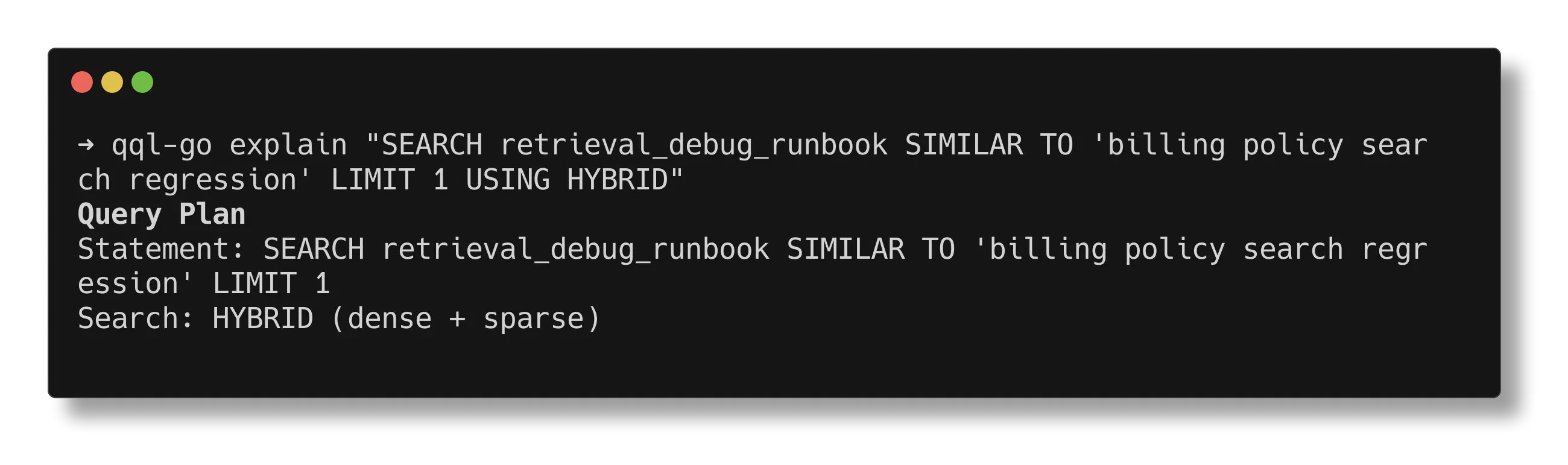
A retrieval-debug-runbook using qql-go enables engineers to analyze the vector stack systematically5:
# 1. Verify connection and cluster health
qql-go doctor --quiet --json

# 2. Inspect target collection schema
qql-go exec --quiet --json \
  "SHOW COLLECTION retrieval_debug_runbook"

# 3. Explain the vector query execution plan
qql-go explain --quiet --json \
  "SEARCH retrieval_debug_runbook SIMILAR TO 'billing policy search regression after index removal' LIMIT 3 USING HYBRID"

# 4. Compare search modes side-by-side
qql-go exec --quiet --json \
  "SEARCH retrieval_debug_runbook SIMILAR TO 'billing policy search regression after index removal' LIMIT 3 USING HYBRID"

qql-go exec --quiet --json \
  "SEARCH retrieval_debug_runbook SIMILAR TO 'billing policy search regression after index removal' LIMIT 3 USING SPARSE"

qql-go exec --quiet --json \
  "SEARCH retrieval_debug_runbook SIMILAR TO 'billing policy search regression after index removal' LIMIT 3 EXACT"

# 5. Rerun with a metadata filter
qql-go exec --quiet --json \
  "SEARCH retrieval_debug_runbook SIMILAR TO 'billing policy search regression after index removal' LIMIT 3 USING HYBRID WHERE team = 'billing'"

# 6. Select and view the expected document directly
qql-go exec --quiet --json \
  "SELECT * FROM retrieval_debug_runbook WHERE id = 4104"
This runbook traces the problem down the stack: checking cluster health, verifying payload index topology, explaining the query weights, comparing retrieval modes (dense, sparse, exact), evaluating filters, and inspecting the raw document payload.
Because the tool outputs structured JSON, engineers can easily copy the diagnostics directly into incident logs.
Workflow 3: Agent-Safe Retrieval for Qdrant
Exposing full SDK access to runtime AI coding agents or sidecar agents presents a security hazard. If the agent’s prompt is injected or if it suffers from a logical error, it can run commands to delete collections or drop indexes.
A restricted, single-purpose CLI like qql-go provides a secure, read-first wrapper around the database:
qql-go exec --quiet --json \
  "SHOW COLLECTION docs"

qql-go explain --quiet --json \
  "SEARCH docs SIMILAR TO 'HIPAA policy' LIMIT 5 USING HYBRID"

qql-go exec --quiet --json \
  "SEARCH docs SIMILAR TO 'HIPAA policy' LIMIT 5 USING HYBRID WHERE department = 'compliance'"
For an agent, this interface is highly structured:
- Declarative String: The model writes a single query line rather than compiling nested SDK payloads.
- Stable JSON Output: Predictable parsing with no regex extraction needed.
- Controlled Capabilities: Command permissions can be restricted to read-only statements (
SEARCH,SCROLL,SELECT), preventing any state-modifying database operations.
This separation of database operations from raw SDK access aligns with modern agent tool boundaries and zero-trust guidelines67.
Workflow 4: Benchmark Packs for Retrieval Quality
Determining whether to use dense search, sparse vectors, or hybrid RRF/DBSF requires testing parameters against real evaluation sets.
The medical-retrieval-ops benchmark in the qql-go repository provisions a medical QA corpus from ChatMED-Project/RAGCare-QA, imports it into Qdrant, and runs evaluation checks across multiple search configurations5:
medical-retrieval-ops/
├── 01-provision.qql
├── build-medical-corpus.py
├── generated/
│   ├── 02-seed.qql
│   ├── benchmark-questions.json
│   └── eval.json
├── run-demo.sh
├── run-benchmark.sh
└── artifacts/
Expressing the benchmark workspace as a set of version-controlled .qql files and scripts ensures reproducibility. Teams can run the benchmark suites offline, verifying how updates to sharding, distance functions, or threshold scoring impact recall metrics before deploying changes to production89.
QQL Files Make Retrieval Work Reviewable
Retrieval configurations and schema setups should live in version control alongside application code. With qql-go, these setups are stored as .qql files:
CREATE COLLECTION docs HYBRID

CREATE INDEX ON COLLECTION docs FOR department TYPE keyword
CREATE INDEX ON COLLECTION docs FOR doc_type TYPE keyword

SEARCH docs SIMILAR TO 'refund policy' LIMIT 3 USING HYBRID
SEARCH docs SIMILAR TO 'billing portal invoice download' LIMIT 3 USING SPARSE
SEARCH docs SIMILAR TO 'security compliance and audit logs' LIMIT 6 USING HYBRID GROUP BY department GROUP_SIZE 2
Automation then executes the scripts:
qql-go execute --stop-on-error smoke-tests.qqlThis is not designed to replace infrastructure-as-code tools like Terraform. It is for database migrations and schema seeds: explicit, version-controlled scripts that define your retrieval setup and verify index health.
Where this fits now
Keep the operational split. Swap the binary.
| Tooling Layer | Primary Use Case | Target Persona | Status |
|---|---|---|---|
| Qdrant SDK | Application hot path, low-latency search | Developers | Current |
| pyqql / nqql (qql-rs) | App code, notebooks, pipelines | Developers | Current |
qql CLI (qql-rs) |
CI checks, runbooks, agent tools | SREs and agents | Current |
| qql-go | Same CLI idea, Go implementation | Archived 2026-08-02 |
The CLI is not an ORM. It makes retrieval quality, testing, and debugging repeatable. Install qql from qql-rs. Do not install qql-go.
The syntax makes Qdrant queries readable. The compiled CLI makes retrieval operations repeatable.
A Practical Starting Workflow
If you want to adopt retrieval operations, start small:
- Create a read-only regression suite: Identify the core queries that are business-critical to your product.
- Codify five target queries: Store the query statements and expected results in a
regression-suite.jsonfile. - Run validation in CI: Execute
qql(qql-rs) against your staging database on every pull request. - Build support runbooks: Replace ad hoc debugging scripts with structured
.qqlsequences.
retrieval/
├── regression-suite.json
├── smoke-tests.qql
└── run-regression.sh
The commands can be simple too:
qql doctor
qql exec smoke-tests.qql
A small, maintained regression suite and a few structured runbooks will capture most retrieval regressions before they impact production users.
Frequently asked questions
Can I query Qdrant from the CLI without the Python SDK?
Yes. Install qql from qql-rs(opens in a new tab). Point it at a .qql file and a Qdrant URL. That is the psql analog: statements in git, results in CI, no notebook required. Do not install qql-go. That repo is archived.
Should I still use qql-go?
No. srimon12/qql-go(opens in a new tab) was archived on 2 August 2026. Use qql / pyqql / @veristamp/nqql from qql-rs. Keep this page for the CI and runbook patterns.
Should application servers use the QQL CLI instead of qdrant-client?
No. Keep hot request paths on the official SDK if that is what you already ship. Use the CLI for regression, runbooks, and a restricted agent tool.
How do I regression-test hybrid search?
Commit .qql files plus expected point IDs (not only a mean nDCG). Run them in CI against a pinned collection snapshot. A 0.2 point metric move can hide a 20% top-1 change. See the per-tenant IDF numbers.
Conclusion
QQL is not a single code repository. It is a language concept: making vector database operations readable, versionable, and repeatable.
The original Python QQL proves the design’s readability. The Qdrant SDKs remain the correct choice for application code. qql-go was the Go packaging of that idea. Current packaging is qql-rs: qql.veristamp.in(opens in a new tab), github.com/srimon12/qql-rs(opens in a new tab). The archived Go tree is still readable at github.com/srimon12/qql-go(opens in a new tab)2.
If you are working on the ingestion side of retrieval quality, RAG Chunking Visualizer in Rust (WebAssembly) is the upstream companion. If you care about agent execution boundaries, Governed Code Mode is the adjacent runtime story. And if your retrieval layer is becoming a maintained knowledge system, Schema-First Extraction for LLM Wikis is the next layer up.
References
Footnotes
-
Kameshwara Pavan Kumar Mantha. “QQL - Qdrant Query Language.” GitHub. https://github.com/pavanjava/qql(opens in a new tab) ↩ ↩2
-
Srimon Danguria. “qql-go” (archived 2026-08-02). GitHub. https://github.com/srimon12/qql-go(opens in a new tab) ↩ ↩2
-
Evidently AI. “A complete guide to RAG evaluation: metrics, testing and best practices.” https://www.evidentlyai.com/llm-guide/rag-evaluation(opens in a new tab) ↩
-
Braintrust. “RAG evaluation metrics: How to evaluate your RAG pipeline with Braintrust.” https://www.braintrust.dev/articles/rag-evaluation-metrics(opens in a new tab) ↩
-
Srimon Danguria. “qql-go examples.” GitHub. https://github.com/srimon12/qql-go/tree/main/examples(opens in a new tab) ↩ ↩2 ↩3
-
xpander.ai. “MCP vs CLI for AI Agents.” https://xpander.ai/resources/mcp-vs-cli-for-ai-agents(opens in a new tab) ↩
-
Endor Labs. “Introducing Agent Governance: Using Hooks to Bring Visibility to AI Coding Agents.” https://www.endorlabs.com/learn/introducing-agent-governance-using-hooks-to-bring-visibility-to-ai-coding-agents(opens in a new tab) ↩
-
Qdrant. “Hybrid Queries.” https://qdrant.tech/documentation/search/hybrid-queries/(opens in a new tab) ↩
-
Qdrant. “Hybrid Search and the Universal Query API.” https://qdrant.tech/course/essentials/day-3/hybrid-search/(opens in a new tab) ↩